The first time we visited Taiwan in July 2024, I wanted to visit Beitou. Located in northern Taipei, it is a mountainous area known for its hot springs and natural wide open spaces.
It was literally too hot to explore so when we returned to Taiwan during the winter, I made sure it was part of our itinerary.
January 16, 2025 from our hotel in the Daan district, we took the Tamsui-Xinyi (red) MRT line to Beitou Station. 10 stops and 40 minutes later, we transferred to the 2 stop pink line train to get to the Xinbeitou station.
This train ride was about 10 minutes long, moved at a slower pace as it climbed its way up to the base of the Yangmingshan mountain. Its interior panels had earthly tones and some of the seats were wooden and set in a strange configuration.
The ride had an eerie vibe that felt like you are being transported to some parallel universe back to a forgotten era in the distant past.
When you step out of the train, the strong scent of sulfur hits your nosetrils The odor is not pungent but it lingers until eventually you get used to the smell as you begin your exploration of this charming and quaint mountainous town.
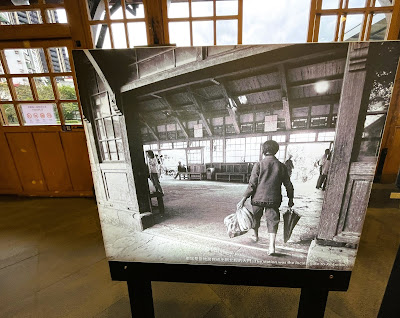
The Xinbeitou historic train station was built in 1916 during the Japanese colonial period. The railway was constructed to promote the rapidly developing hot springs industry in the area. It was built with wood, featuring carved eaves and unique 3+1 dormers (the circular wooden windows located on the roof).
In 1988, the Tamsui railway line was abolished due to the construction of the Taipei MRT so the station was moved to Changhua county located just south of Taichung.
After various obstacles, the Xinbeitou Station was donated back to the Taipei City Government Department of Cultural affairs. In 2017, after some renovations, the oldest train station in Taipei was re-opened to the public.
It has transformed from a transportation hub into a cultural center for the Beitou community. Its exhibits displaying images and photographs as well as documents, poems and diaries to showcase the fond memories, people have of the beloved railway station.
It is open from Tuesday to Sunday from 10 A.M. to 6 P.M. Entrance is free.
 |
| Blue sulfur springs contain the rare element Radium. You can soak your hands even entire arms in these hot spring hand soaking pools. Water is really hot but therapeutic |
Throughout Beitou, everything is within walking distance. The Beitou stream is visible and you can actually see the steam vapor emanating from the river so imagine how hot the water must be.
When the Japanese occupied northern Taiwan, they discovered hot springs and geothermal resources so people began to enjoy open air hot baths in the Hokuto stream (Beitou Stream) which originates from the hot springs of the geothermal valley.
"Taki" is a Japanese term for a waterfall descending along a multilevel riverbed. There are 5 taki in the Beitou Stream.
Numerous hot spring hotels abound on both sides of the main street. You can take your pick for staycation or spend several days just soaking in the natural and therapeutic hot springs.
Most of them offer packages that include accommodation with or without breakfast + hot spring/spa treatment with different rates.
 |
| Ketagalan culture center. Ketagalan are the Taiwanese aboriginal people who originated from the Taiwan basin and now live in northern Taiwan |
 |
Beitou public library is Taiwan's first green library. Built of wood and steel, it has solar panels on its roof, eco friendly wooden balcony railings and its sloping roof drainage
system collects rainwater to water the plants and flush the toilets.
|

T
he Beitou Hot Spring Musuem is over 2,300 sqm and has two floors. To preserve this valuable cultural monument, you have to change your shoes into indoor slippers which are provided in the entrance.
Opening hours: Tuesday to Saturday from 10:00 AM to 6:00 P.M.
Entrance fee: NTD 120 and 50 NTD for seniors and students.
It is now designated as a city monument so it does not provide bathing services.
Formerly known as Beitou Public Bathhouse (Hokuto Public Bathhouse), it was the largest public bath in East Asia at that time.
The first floor consisted of the bathing area while a resting area occupied the second floor.
Usually after bathing and changing clothes, the visitors would proceed to the second floor's tatami lobby to rest, have tea or a meal, play chess or walk to the balcony for a scenic view of the Beitou Stream.
The Beitou Stream is home to the rare mineral Hokutolite which is formed as the green sulfur hot springs from Hell Valley and the waterfalls or "taki" descend into the thermal valley - the main source of the Beitou Sream.
It takes about 120 years for a single centimeter of Hokulite to crystallize so it is fairly rare.
A piece of Hokulite weighing 800 kgs is the most precious collection in the Beitou Hot Springs Museum.
Among more than 4,000 minerals in the world, the only toponym named after a Taiwanese place is Hokutolite and is considered a Beitou Stream treasure because it takes a long time to form and is endowed with special properties.




1 comment:
I will keep this place in mind in case I get to visit Taiwan again.
Post a Comment